
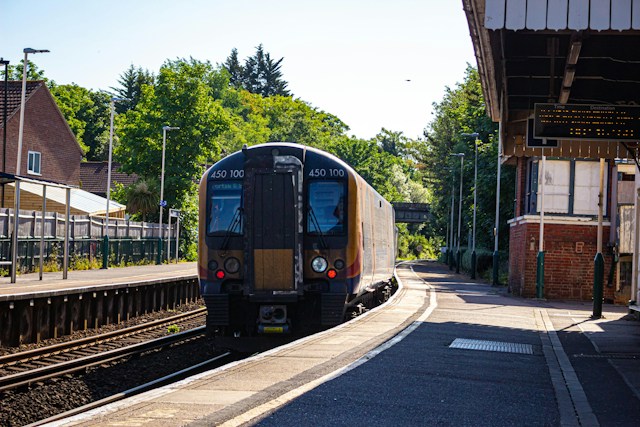
Natalie stepped in to cover the first part of the debate clashed with the Public Accountability Bill debate…
Amendment 114A moved by Baroness Bennett of Manor Castle
Baroness Bennett of Manor Castle
114A: After Clause 17, insert the following new Clause—
“Passenger modal shift target(1) The Secretary of State must, after consulting the Scottish Ministers and the Welsh Ministers, set and publish a target, specifying a date by which it is to be achieved, to increase the overall distance travelled by passengers by railway.(2) In setting the target, the Secretary of State must have particular regard to—(a) increasing the distance travelled by passengers by railway relative to travel by private car and domestic air services, and(b) increasing the distance travelled by passengers by railway where railway travel forms part of a journey involving active travel, bus, tram, metro, coach, ferry or other public transport services.(3) The Secretary of State must, in respect of each year, prepare, lay before Parliament and publish a report setting out progress towards meeting the target, the steps taken to meet it and the steps proposed to be taken in the following year.(4) The Secretary of State must review the target at least once in every period of five years.
(5) The Secretary of State may revise or replace the target only if the revised or replacement target is no less ambitious than the target it revises or replaces.(6) Before revising or replacing the target, the Secretary of State must consult the Scottish Ministers and the Welsh Ministers.(7) Great British Railways must, when exercising its statutory functions, have regard to the target set by the Secretary of State under this section.”
Member’s explanatory statement: This amendment requires the Secretary of State to set a target to increase the distance travelled by passengers by railway.
Natalie’s speech: Lords, observant noble Lords will have noticed that I am not my noble friend Lady Jones of Moulsecoomb. She apologises that she is currently occupied in the Chamber with the Public Office (Accountability) Bill, although I hope she will rejoin the Committee shortly. My qualifications for taking part in this Committee are that, over 14 years, I have travelled an enormous number of train miles across these islands and I am passionate about greatly improving the reliability, affordability and practicality of train travel. I just looked at my diary and, in the next 10 days, I have journeys to Kidderminster, Manningtree, Sheffield and Manchester. I have my fingers crossed.
In moving Amendment 114A, I will speak primarily to all the other amendments in this rather diverse group, described as “general duties”. I briefly express sympathy with Amendment 118 in the name of the noble Lord, Lord Parkinson of Whitley Bay. I have heard the noble Lord on the subject of heritage railways many times, and I look forward to hearing him again.
Amendments 114A and 118B are about the role we expect Great British Railways to play in getting people on to rail, given the climate and environmental crises. At the moment, the Bill downgrades the role of the environment, at a time when we absolutely cannot afford to do that. Transport is the UK’s highest polluting sector, and a modal shift duty is an absolute must.
There is a reference in Clause 18 to the effect that railway services have on the environment, but it is a relatively narrow formulation. It is essentially about minimising the harm caused by the railway. We should ask for something much more ambitious: how can the railway itself be a tool in reducing emissions and car dependency, which could have positive cost of living impacts for families and communities, as well as helping us respond to the climate and nature emergencies.
There are demonstrations of what is possible across these islands. Wales has put clear numbers on this. Its transport strategy aims for 45% of journeys to be made by walking, cycling or public transport by 2040. Its net zero Wales commitments include reducing car mileage per person by 10% by 2030, from a 2019 baseline, and increasing journeys by sustainable modes to 39% by 2030.
Scotland has also recognised the importance of reducing car use. It previously set a target to reduce car kilometres by 20% by 2030 from a 2019 baseline. The Scottish Government have since acknowledged that this target is off track and are revising it according to a longer-term target aligned with their climate objectives, but the policy commitment to reduce car use is still there.
There is another important difference. Under Section 44 of the Climate Change (Scotland) Act 2009, Scottish public authorities already have a statutory duty, when exercising their functions, to act in a way best calculated to contribute to Scotland’s climate targets and programmes. But Great British Railways, the Office of Rail and Road, and the Secretary of State will not have an equivalent overarching statutory climate duty under this Bill unless changes such as those proposed here are made. If Scotland and Wales can do this, why not us?
Amendment 127 is on affordability. It is obvious that, if we want people to choose trains over cars and planes, trains have to be affordable. I can cite many examples of where this clearly is not the case. Which? found a return journey from Edinburgh to Bournemouth costing £127 by train—I think I have made that journey, and it is not a great pleasure—compared to £38 by plane. Glasgow to London was £101 by train, compared to £67 by plane. At times, I am sure we could find even worse examples. We cannot seriously expect people to choose rail if it costs two or three times as much as flying.
Affordability is not just about the cheapest ticket you can find online. People have to travel when they need to travel. People on low incomes, shift workers, young people, passengers with disabilities and people living in rural and coastal areas, where there are few alternatives, are often faced with simply impossible costs. We need a clear duty on the Secretary of State and Great British Railways to improve the affordability and fairness of fares, with particular regard to those groups. I therefore explicitly ask the Minister: what is the Government’s ambition for affordable fares under Great British Railways? Will they consider putting that ambition into the Bill?
I come, finally, to Amendments 330K and 334A on the regulation of licences. These are about the relationship between the general duties of the Bill and the licences that will govern the railway. Under the 1993 legislation, licence conditions must have regard to the general duties. These amendments would make sure that this same connection is carried throughout the Bill. As I understand it, with the way the Bill is currently drawn, that link is being removed. This seems important, because the Bill gives us a set of general duties for Great British Railways, but then the licensing framework is no longer required to have regard to them. What will guide the conditions that are put on the licence if the Government are indeed taking away this duty? That is another direct question to the Minister. More broadly, where do these general duties sit in the hierarchy? If they are not reflected in the licences, while competition law and other regulatory requirements continue to have strong legal force, the duties could become more of a statement of intent than something that shapes how the railway is regulated. I beg to move.
Clause 19: Safety duty of Ministers and ORR
Amendment 131 moved by Baroness Jones of Moulsecoomb
131: Clause 19, page 11, line 31, insert—
“(aa) the exercise by Great British Railways of its statutory functions, and”
Member’s explanatory statement: This amendment adds Great British Railways to the parties with safety duties under Clause 19.
My speech: what a pleasure it is to be back on the Railways Bill with a dozen transport nerds. It is such a wonderful way to spend my Monday evening. I say to the noble Baroness, Lady Grey-Thompson, that I have been talking about climate change for 38 years, and I am barely closer to what I was talking about at the very beginning.
I have Amendments 131, 132, 144 and 338 in this group. I want to explore the tension between safety and competition in the Bill. As the Railways Bill retains the competition law framework established during privatisation—in fact, it extends it further—we can call it the ultimate legal framework for the entire Bill. The concerns go beyond the duty to promote competition. Under Section 67(3) of the Railways Act 1993, the Office of Rail and Road has significant powers to enforce competition law alongside the Competition and Markets Authority. These are much stronger powers than simply encouraging competition.
The problem is that the Bill gives these competition functions priority over several other responsibilities, including the ORR’s general duties and, in some circumstances, its safety duties. It also limits the guidance that UK and Scottish Ministers can give the ORR on competition matters. In effect, competition regulation is being given priority over wider public interest decisions and democratic oversight, and we have to ask whether that is appropriate for a publicly-owned railway. Why should we carry forward and even extend a competition framework inherited from privatisation rather than putting the public interest at the centre of how our railways operate?
There is some reassurance in the fact that safety functions are protected in several of these provisions, but that does not resolve every potential conflict between safety and competition regulation. Wherever those responsibilities could pull in different directions the Government need to explain how that conflict will be resolved and why competition should ever take precedence over safety. That is my Amendment 131.
On Amendment 132, the new safety duty on Ministers and the ORR in Clause 19 is quite shocking: they
“must take into account the need to protect all persons from dangers arising from the operation of railways”.
This clearly has an exemption for competition regulation, which can only mean that, in a trade-off between competition and public safety, competition will win. That exemption should be struck, and we need a proper explanation of why it is present in the first place.
Clause 19’s safety duty does not currently apply to GBR, only to the ORR and Ministers. I would like to know the reason for that. Is it also in any way competition related? Amendment 131 would explicitly add Great British Railways to the safety duty in Clause 19 so that it applied not just to Ministers and the ORR. As we move to a new rail structure, it should be clear that Great British Railways has a responsibility to put safety first when carrying out its functions. It is difficult to see why decisions about competition should be exempt from a duty that exists to protect passengers and railway workers. Competition decisions can have wider consequences for how the railway operates, and safety has to be part of those considerations.
More broadly, I am concerned that the Bill gives too much weight to competition rather than putting public interest at the core of our railways. The purpose of our rail network should be to provide safe, reliable and well-integrated services for passengers, not to create more opportunities for commercial operators.
On Amendment 144, ultimately the ORR’s safety function should be above all other duties. This is a railway, one of the most potentially dangerous industries there is. It is not satisfactory even if safety is formally equivalent to competition. Rather, safety must take precedence over competition regulation. That is why Amendment 144 proposes a priority of safety functions clause, ensuring that there cannot be a trade-off between competition and the safety of the public and rail workers under any circumstances and that this parity is made clear and distinct in law. Taken together, these amendments would strengthen the safety duties on Great British Railways and the ORR and make clear that safety must come first.
Public ownership has to be about more than just changing who runs our railways. It should mean putting passengers, railway workers and public interest ahead of competition. That is why I have called for Clause 20 to be removed from the Bill. We do not believe that a statutory duty to promote competition belongs in this Bill. It puts competition at the centre of the regulator’s responsibilities rather than focusing on what passengers need from their railway. Plus, there is already too little in this Bill about tackling the climate crisis and making rail travel affordable. We should be looking at how to get more people on to public transport, reduce reliance on cars and make sure that taking the train is a realistic option for people on ordinary incomes. Those should be central priorities for our railway.
On to Amendment 338, there is the question of the status of the ORR’s safety duties under the Deregulation Act 2015, inserted by the Economic Growth (Regulatory Functions) Order 2017. This is not mentioned in the Bill as it stands, but this probing amendment suggests that the ORR be removed from that order. The reason is not, in this case, anti-growth. It is because, as few people seem to be aware, it relates to the ORR’s safety function specifically requiring it to consider the importance of exercising the regulatory function in a way which ensures that
“regulatory function is taken only when it is needed, and … any action taken is proportionate”.
Although this, in itself, does not override safety duties, it is clearly intended to influence decisions about what to investigate, when to intervene and whether to use formal enforcement. It is fair to say that it fundamentally has the effect of putting safety enforcement below competition regulation in a hierarchical sense. I beg to move.

