Privatisation of rail has given us higher fares and generated a fat profit for all the state-owned German and French rail companies, which took advantage of UK taxpayers. I congratulate Labour on bringing this to an end. But why not end the disastrous mistake of water privatisation that will cost £12.5 billion in this Parliament alone, only to pay shareholders and creditors, but which will still result in waterways full of faeces, agricultural run-off, other chemicals, drugs, paint, bleach and plastic? If water companies collapsed, we could buy them for pennies and run them ourselves. Continue reading “Passenger Railway Services (Public Ownership) Bill Second Reading”
Category: Cycling, roads and public transport
Our streets should belong to people first, vehicles second
Jenny has worked to make safe space for walking and cycling, to improve public transport and to reduce traffic levels
Read on for her latest posts on this topic
Regulation of cycles debate
For those suggesting a registration scheme for cyclists, I say that experience has shown that it would soon become impossible to enforce and the main impact would be to put another big barrier in the way of people who want a cheap, convenient, environmentally friendly and healthy way of getting around. If we want a culture of safe and law-abiding cyclists, making cycling easy, safe and segregated from cars is the way to do it. Continue reading “Regulation of cycles debate”
My new Clean Air Bill
I just entered my bill for the new session into the Lords Private Member’s Bill (PMB) ballot Continue reading “My new Clean Air Bill”
National Networks National Policy Statement – a message to Labour
These national policy statements were Labour’s idea – and they are a really good idea. To make them work, we have to make sure that the Treasury listens and that the next Government get the funding to deliver real change. We need to imagine a future that is better than what we have now and spend the money building that future
Continue reading “National Networks National Policy Statement – a message to Labour”
Transitional Biomass Subsidies protest
On 5th March Biofuelwatch and the Stop Burning Trees Coalition held an emergency demo outside the Department for Business, Energy and Industrial Strategy in response to the Government’s proposal to offer billions more in new ‘transitional’ subsidies for unabated wood biomass burning. This goes back on previously government policy to stop all subsidies for unabated biomass burning in 2027. The only two power stations eligible for these subsidies are Drax (the UK’s biggest carbon emitter) and Lynemouth. These subsidies have no clear end date in sight, so if approved, could lock us into decades more of forest destruction, pollution of communities and carbon emissions. We called on DESNZ to scrap these plans to keep funding tree burning, and invest in genuine renewables and climate action.
Road Danger Reduction Forum: Celebrating their 30th Anniversary
HS2 Costs
Lord Berkeley asked HMG what assessment they had made of reports alleging that HS2 Ltd did not disclose accurate cost estimates for the project and the Sunday Times offered a helpful list of what that £100 billion could have been spent on, including 270,000 nurses, 1 million council homes, 200 hospitals or 10,000 schools. I asked: Have this Government looted the public purse for so long—13 years—that they do not understand how important it is to keep track of this sort of alleged corruption?
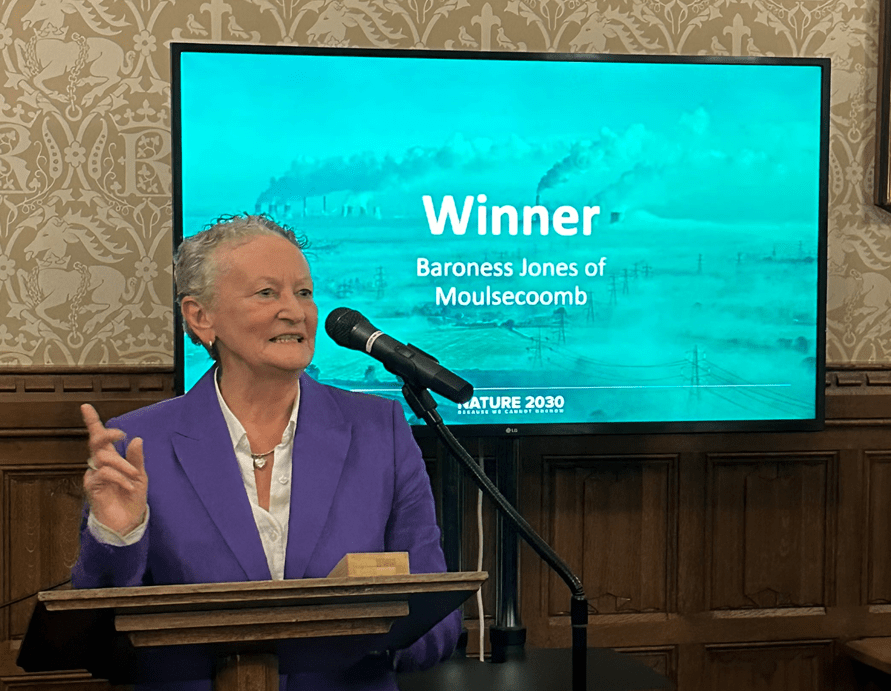
Green Party recognised at Nature 2030 Political Purpose Awards
Our Westminster representatives won two of the six Nature 2030 Political Purpose Awards: Jenny won the 2023 Pollution, Waste & Air award and Caroline Lucas MP won the Lifetime Achievement award at the inaugural Political Purpose Awards held at the House of Lords on 20th September.
Continue reading “Green Party recognised at Nature 2030 Political Purpose Awards”Aviation
Jenny yesterday introduced Natalie’s aviation amendment to the Levelling Up Bill: the amendment proposed a review to examine the costs and benefits of planned expansion of the UK air transport sector and was based on a report from the New Economics Foundation entitled Losing Altitude: The Economics of Air Transport in Great Britain Continue reading “Aviation”