Sentient creatures and Brexit

The Commons came within 18 votes of passing a Caroline Lucas amendment to the EU Withdrawal Bill which would have included protection of sentient creatures. Early next year I shall put this same amendment to the Lords. It is an existing EU principle and one of many principles underpinning EU law and regulation that have been rejected as amendments by the government.

Continue reading “Sentient creatures and Brexit” →

Will new nukes go broke?

A new German-Finnish study suggests renewables paired with storage systems could power the entire globe by 2050. This is good news for the planet and bad news for EDF, the main company behind the Hinkley C nuclear power station. The study estimates that the cost of making renewable energy available every hour of the day, every month of the year will fall to €52/MWh, well below the strike price set for Hinkley C, which starts at £92 and rises with inflation. Continue reading “Will new nukes go broke?” →

Pesticides in our food, our soil and our countryside

I asked the Government what steps they are taking to protect rural communities from pesticides and whether they intend to adopt non-chemical farming methods post-Brexit. It is almost inevitable that my question achieves little more than raising a neglected issue on behalf of neglected communities. However, it does allow other peers to join in with their own set of constituent concerns or issues. Continue reading “Pesticides in our food, our soil and our countryside” →

Transparency Statement

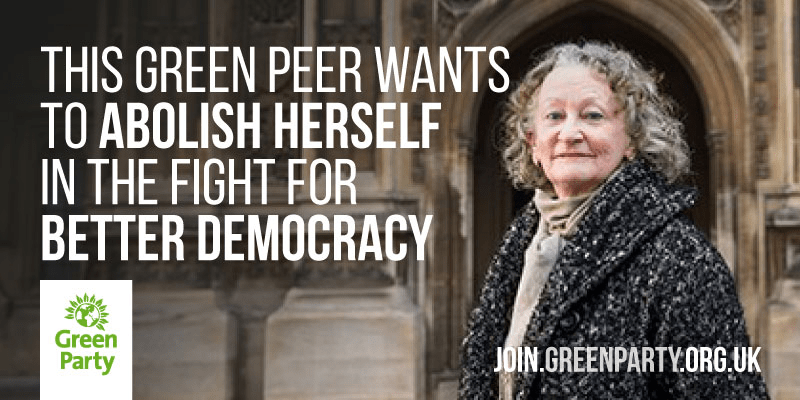
Jenny is full-time at the House of Lords and receives an attendance allowance of £332 per day if she attends the main chamber during debates, which she does daily when the Lords is sitting. This is her only income other than her pension; she does no other paid work and claims no other expenses

When Jenny is not in the Chamber, she is usually in her office preparing for debates and dealing with correspondence, meeting with NGOs, campaigners or other Peers, speaking at events, visiting protests or pickets, visiting local Green Parties, showing visitors round the House, or doing media interviews. You can view members’ allowance uptakes here

Jenny ​has an above-average attendance and question-asking record which can be viewed on the They Work for You website here

Jenny hosts events for a variety of NGOs and campaign groups, which gives them access to MPs and other Peers as well as increased profile. She organises tours of Parliament for groups of Green Party members on request. Her work continues during recess, when there is no attendance allowance, when she continues to attend events, protests and local Green Party groups.

Jenny has a small flat in London which she shares with her elder daughter during the week. She spends her weekends in Dorset in the bungalow she shares with her partner; they have an allotment and no car or pets. She hasn’t flown in a number of years

A list of lobbying groups and individuals that Jenny or her office has had substantive contact with is available here

​Jenny and Natalie’s office team are all part-time and employed by the Green Party of England and Wales

Jenny twice received £22,000 as a private donation from an ecologically minded philanthropist which went towards staff costs and has also raised money via crowd funders

You can see the Lords register of interests – which includes a record of donations and gifts – here.

Your privacy and the latest executive power grab

The Data Protection Bill will be discussed in the Lords this afternoon and it contains a lot of sensible reforms on how we protect private information. However, it also contains a lot of Henry 8th powers giving Ministers the right to by-pass Parliamentary scrutiny if they want to change the law in the future. This is an obvious threat to democracy. Giving such Putin powers to this government is a bad idea, and it remains a bad idea if a Corbyn government takes charge in a few years’ time as the powers give the executive the ability to change the rules, and that is always a bad idea. Continue reading “Your privacy and the latest executive power grab” →

Why I wear both the red and white poppy

I wear a red poppy, but I wear a white one too. One of the defining features of modern wars is the vast numbers of civilians who are killed as well. Over 140,000 civilians are estimated to have died in the Iraq war or its aftermath. The white poppy is one way of remembering them. From those thousands in Iraq to the Londoners who died in the blitz and the citizens of Nagasaki and Hiroshima, the white poppy speaks for them. When the red wreaths are laid at the cenotaph and at numerous memorials around the country, would a wreath of white poppies be out of place? Should we remember all of the dead, or only those in uniforms? Continue reading “Why I wear both the red and white poppy” →

Government passes buck on safety after Grenfell fire

The Government is failing to support local authorities and social housing providers who want to make safety improvements in tower blocks as a result of lessons learned from the Grenfell fire. Despite the early rhetoric about residents’ safety being paramount and therefore money not being a problem, it clearly is a problem. One local authority after another is having their request for funding turned down and they are being left with the bill for replacing cladding or installing sprinklers. My concern is that housing providers are paying money they can’t afford to compensate for Government mistakes in not updating the safety regulations.

Continue reading “Government passes buck on safety after Grenfell fire” →

Housing for the community

I raised two crucial issues about community housing in the Lords. First, the need to put an end to estate demolitions that destroy working-class communities. I have seen several council estates demolished against the wishes of the residents themselves and when rebuilt the social housing is less affordable and some of the housing is sold off privately and very expensively. I understand why Labour councils do it; they have been kept short of money by this Government. But it is an extremely damaging process.

My second point is about boosting community-owned housing. It has often been said that more housing could be built but often nimbys are blocking it—but in fact, many communities are stepping up and providing more affordable homes through community-led housing. Such groups have already built 800 homes in recent years, many in areas of outstanding natural beauty, having won support for more homes than the local council thought likely or even possible. In the spring of 2016, the Government announced the community housing fund, designed to help community-led groups build affordable homes. It could help them to build a further 12,000 homes over five years. The first year’s money went directly to councils, but the Government has still not released any funding for this financial year, more than halfway through the year. When I asked the Government in July when the money would be released I was told, “In due course”. The appropriate time would have been in March, after the sector submitted a detailed proposal to the Government. The longer it waits, the more projects get stuck in limbo and the fewer homes acceptable to local communities can be built. A decision from the Government on the community housing fund is long overdue. When will it happen?

My questions and the response can be found here