Amendments

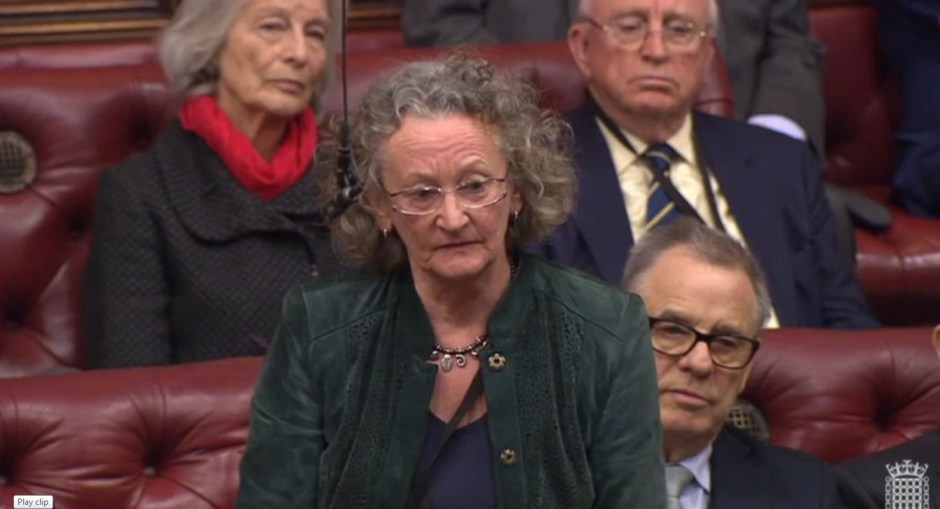
The text below is from when Jenny gets to tell the House about the  amendment she has tabled. The links are to Hansard where you can read the actual amendment text which makes little sense out of the context of the bill. She initially moves the amendment, then she speaks to it and then, like as not, she withdraws it for lack of support

23rd November 2016   Bus Services Bill – Third Reading 

My Lords, I was very pleased with the support, sympathetic noises and comments that I had from other Peers when I first tabled this bus safety amendment and I have brought it back at Third Reading, with thanks to the Minister for not disallowing it. The amendment was drafted with the assistance of the Campaign for Better Transport’s “Save our Buses” campaign and benefited from written evidence submitted to the Transport Committee by the Parliamentary Advisory Council for Transport Safety, or PACTS. It was largely rewritten by the campaigner Tom Kearney, who has been the victim of a bus crash.

The amendment seeks to do two things. First, it would help with confidential reporting, meaning that bus drivers would have access to a system that has long been happening on the railway and within the air industry. This is called the confidential incident reporting and analysis system, or CIRAS, and it means that bus drivers could report anything about faults or problems that they perceived with their vehicles or their routes.

Secondly, it would allow for the quarterly publication of bus casualty data. When we were on the London Assembly, the Greens persuaded Boris Johnson, when he was London Mayor, to improve operational safety performance monitoring and reporting of TfL’s bus routes by adopting this measure. As a result, confidential safety reporting has been in place in London since 4 January this year. TfL has also made its bus operators’ subscription to CIRAS a precondition for running a bus service contract. These safety practices have made London’s bus system, which is about 25% of the UK’s entire bus fleet, substantially more safety conscious. London also has access to casualty data reporting, which has been in operation for nearly three years, since January 2014. TfL publishes bus safety data every quarter, clearly identifying the bus operator involved, incident location, type of injury, sex and age of the injured party, general cause, mode of transport involved, and borough and month in which it happened.

The importance of confidential safety reporting is shown by the statistics now published by Transport for London. The latest statistics suggest that every TfL bus driver has a 0.2% chance per annum of killing someone; a 63% per annum chance of injuring someone; and a 0.016% chance of sending someone to hospital every single day. Given that safety incidents impose costs and cause delays, one would think that bus operators would be motivated to encourage such reporting by their employees. Surprisingly, even though London’s bus operators have franchises across the UK, only their London franchises are subscribed to CIRAS. While I support the idea of localism, it seems strange to me that London’s bus franchises should have a manifestly better operational safety reporting system than any other locality in the United Kingdom.

In the rail industry, 2015 marked the eighth year in a row with zero rail crash fatalities. This year of course we have had the Croydon tram fatalities. I do not know whether the Croydon tram was operating under CIRAS conditions; I would be interested to know whether it was, if the Minister knows and can tell us. We have acted for many years to prevent rail crashes and deaths, so I fail to understand why we so readily accept crashes, injuries, incidents and deaths on our roads.

As a result of the Minister’s previous comments, I have redrafted this amendment so that the section on confidential safety incident reporting conforms to existing rail standards and CIRAS’s name no longer appears, which would mean that it is not quite so time-limited as it might have been before. I hope that these tweaks will remove the barriers to the Government’s acceptance of this incredibly common-sense proposal. I beg to move.

Spoke again later in debate: My Lords, I thank the Minister for his generous reply. Obviously he did not go as far as I would have liked and I hope the House will allow me a little leeway in demolishing—or commenting on—some of the comments that have been made during this debate.

Earl Attlee: complexity. I have never driven a train or a bus but, as a train is taken along tracks with no steering wheel, it could be argued that a bus is more complex to drive and that there are more complex issues on roads. So that is quite a feeble argument.

Lord Snape, I did not quite follow what you were saying but I can assure you that, from an extra burden point of view—if you are talking about a financial burden, for example—if a company has a turnover of up to £1 million, it would cost it £300 to subscribe to the scheme. If its turnover is from £1 billion to £2 billion, it is £12,000. That is not onerous. You might argue that the data collection is onerous—but I would say, “No data, no measurement”. We cannot judge whether a company is safe if we do not have the data to look at. So this is money well spent.

Lord Horam, you talked about my interesting ideas—I think that was a criticism rather than a compliment—and you also called this heavy-handed. I can only say to you that this is tried and tested in London and it works for the majority of bus companies. You talked about London buses being so good, but they are so good partly because they subscribe to this scheme and bus drivers are allowed to comment on their vehicles and the problems they face. I thank the Peers who commented in a positive way and I shall come to the Minister’s comment in a moment.

Spoke again later in debate: I do apologise. I have no idea about that. Perhaps you would like to give me a seminar afterwards.

The noble Earl, Lord Attlee, questioned whether or not he was consistent between my bringing the amendment last time and now, I can assure the noble Lord that he was completely consistent. He did not like it then and he does not like it now.

I thank the Minister for the productive meeting and it was good to hear that he was sympathetic to the issues. This is a relatively minor change. Other people have called it heavy-handed but it is a minor change. It saves lives. I cannot think of a higher, nobler cause than saving lives—especially those of the people we purport to govern. We are saving lives and preventing injuries and devastation to families—and the numbers we are talking about are not inconsequential. This is a relatively light touch for something that has such heavy consequences. I am of course disappointed that the Government have not snapped up the amendment but I look forward to it being picked up later.

Its impact on society and on the taxpayer is much heavier than we realise. Every crash has a cost—whether it is in delays to business, to the service or to commuters—that we do not assess. When we talk about the cost to industry, we should also think about the cost to the life of the towns, cities and roads where it happens.

Spoke again later in debate: I thank the noble Baroness, Lady Scott, for that comment. I actually do not know the answer to that and I will find out.

I hope that the economic impact of deaths and injuries will be taken into account by the Government when they assess the importance of this amendment. Having said all that and feeling only slightly better—I mean bitter—I beg leave to withdraw the amendment.

17th October 2016   Investigatory Powers Bill – Report stage (2nd Day)

My Lords, with this amendment I make a further attempt to introduce into the Bill a requirement on the authorities to demonstrate reasonable suspicion of a serious crime and a nexus between the communications data that are sought and the crime suspected before a targeted surveillance warrant can be authorised.

As I pointed out previously when speaking to Amendment 20, one of the greatest problems with the Bill is the lack of a requirement for reasonable suspicion in order for surveillance powers to be authorised for the purpose of preventing and detecting a crime. At the moment, intrusive powers can be authorised to prevent and detect serious crime, but this general purpose is left wide open to very broad interpretation, and therefore to abuse, without requiring the authorising authority to verify the existence of reasonable suspicion of criminality. A requirement of reasonable suspicion when the purpose of preventing and detecting serious crime is invoked would prevent the potential abusive surveillance of law-abiding citizens, which we have seen in the past, without unduly limiting the legitimate use of surveillance powers.

The threshold of reasonable suspicion has long been an important safeguard for both citizens and law enforcers against the risk of the arbitrary use of police powers. The “necessary and proportionate” standard invokes an important assessment of the extent of the intrusion but does not necessitate a threshold of suspicion. Although would one expect that in practice targets of surveillance would meet this very modest burden of proof, in my view it is a great mistake not to include the threshold of reasonable suspicion in the Bill, and it leaves these powers ripe for abuse. Therefore, I make no apology for returning to this issue once again.

The amendment simply requires, first, a threshold of reasonable suspicion that a serious crime has been planned or committed and, secondly, a factual basis for believing that the targeted communications data will contain information relevant to the criminal investigation. This would reassure the public that intrusive targeted surveillance could be used only where there was reasonable suspicion of a serious crime. To that end, I hope the Government will accept the amendment. I beg to move.

Spoke again later in debate: I thank all noble Lords who have given me some support: it is something that I feel very strongly about. I thank the noble Earl for his full reply. Needless to say, I am not convinced because all of the issues that he talked about are in fact potentially serious crimes, so the threshold would be satisfied.

If the noble Earl had spoken to some of the people who had been blacklisted, for example, and whose lives were basically destroyed because of illegal surveillance and co-operation by the police with various organisations, it is possible that he would have been influenced in the same way that I have been. However, in view of the noble Earl’s answer, I beg leave to withdraw the amendment.

12th September 2016   Investigatory Powers Bill – Committee (6th Day)

My Lords, the amendment seeks to put right a government oversight: there is no definition of national security under general definitions throughout the Bill. A principal statutory ground for authorising surveillance is “in the interests of national security”, another is “economic well-being” as far as it relates to national security. Left undefined, national security is unnecessarily open, broad and vague and, I suggest, likely to be abused. As the decision will continue to lie with the Secretary of State, the test will be met by whatever she or he subjectively decides is in the interests of national security or the economic well-being of the UK, so that individuals cannot foresee when surveillance powers might be used, granting the Secretary of State a discretion so broad as to be arbitrary. In the past, domestic courts have responded with considerable deference to government claims of national security—and not just domestic courts but other political parties at times. They have viewed them not as a matter of law but as Executive-led policy judgments. National security as a legal test is absolutely meaningless if left without a statutory definition.

The Joint Committee on the draft Bill recommended that the Bill should include definitions of national security and economic well-being. It is confusing even to use the measure of economic well-being, which should be subsumed, as recommended by the ISC, which found it “unnecessarily confusing and complicated”, saying that the agencies and Home Office had not “provided any sensible explanation” for including the term. I look forward to the Minister supplying that sensible explanation. Therefore, the core purposes for which extraordinary powers may be used remain undefined and dangerously flexible. The undefined tests of national security and economic well-being risk interference with political and other lawful activity that ought to be unimpeded in a democratic society. In an era when parliamentarians from both Houses have been subjected to inappropriate surveillance by security services and the police, the continued undefined use of these terms in enabling legislation is not appropriate or sustainable. I beg to move.

Spoke again later in debate: Why was the phrase “economic well-being” included as a rather loose term?

Spoke again later in debate: My point is simply that there was a recommendation that it was unnecessarily confusing. Therefore, there must be a reason for putting it in, and I would like to know the reason; that is all.

Spoke again later in debate: I thank the Minister very much for those answers. I also thank noble Lords, who obviously did not agree with me, for their comments. This definition was meant to be a prompt, guidance, not something to be set in stone. Without a definition, I find it difficult to understand how we can describe anything that is necessary for the future well-being of the country. The whole Bill is based on a definition. However, if you have not described it, how can you be sure that you are doing the right thing? Nevertheless, given the explanation provided, I beg leave to withdraw the amendment.

9th January 2015: Infrastructure Bill — Commons Amendments

My Lords, I shall try to reintroduce the original Amendment 21 that went through the other place. It was a Labour amendment, supported by the Government. The Minister has said that this government amendment has the spirit of the original Amendment 21 but, to be quite honest, the Government have missed out some detail that is absolutely crucial. I am also quite interested in some of the scientific advice that the Government have taken; some noble Lords may know that in Wales there was a vote last week to pass a fracking moratorium, as there was in Scotland the week before, until the risks could be assessed. It is those risks that I would like to mention today. A scheduling farce has meant that there has been very little time to debate this, and no time for a vote on Report in the Commons.

I feel that the Government are doing a U-turn here. It is not good enough to pass something in one place and then change part of it quite substantially. There are two issues in particular that I want to raise. The first, crucial point is the possibility of fracking near groundwater sources. There is also the issue of trespass under people’s homes. The amendments that went through the other place were already probably not sufficient to protect against all sorts of risks, but at least they were there. The amendments submitted by the Government today may overturn even those quite limited protections.

On the issue of fracking within groundwater source protection zones 1 to 3—that is, the areas around aquifers that safeguard our drinking water—we have heard that the Government might possibly redefine those areas, but they have already been defined by the Environment Agency. There is no reason to redefine them when they have been defined for many years. Our drinking water needs protection; I cannot believe that anyone here does not agree with that.

Spoke again later in debate: I thank the noble Lord for his intervention. Fracking of course risks earth tremors and earthquakes and therefore water could be polluted very easily, so I would argue that his comments have no merit.

Spoke again later in debate: It is very close at hand if the noble Lord would like to look at it. I can give him any number of sources; I do not have them to hand at the moment but I would be delighted to give them to him afterwards. I am sure that Friends of the Earth and so on would be very pleased to send him a briefing on all this, as they have gone into it extensively.

Spoke again later in debate: I thank the noble Lord for that intervention. The noble Lord, Lord Smith, who was then chair of the Environment Agency, reported to that Economic Affairs Committee that,“groundwater contamination is the biggest environmental risk in the Act”.

The Labour spokesperson in the other place said that it was all or nothing: if the Government did not accept the amendment, including banning fracking near aquifers, the Labour Party would oppose fracking altogether. I look forward to that party reaffirming its opposition today. People might assume that as this is an unelected House, nobody watches what goes on here, but people do watch and they care out there. Fracking is a very controversial issue; people have already voiced their concerns and will continue to do so. A government U-turn on this is unforgiveable.

The second issue is that of trespass. I think there is a later amendment that deals with this, but it does not go far enough.

Groundwater contamination is one of the key environmental public health risks from fracking and is a huge risk to the well-being of the population. In some parts of the UK, more than 70% of public drinking water comes from groundwater. As for the Government promising to redefine groundwater source areas, that is a secondary legislation issue. The original idea from the Labour amendment was, however, that this should be in the Bill; it should be primary legislation, not secondary.

A leaked letter from the Chancellor had instructions to pull out all the stops to make for an easier life for fracking companies. This is probably not surprising when our Prime Minister has said that we are going “all out for shale”. I can accept that that side of the House is very gung-ho on fracking but I hope for something better on this side. The original Amendment 21 would also give us an opportunity to vote against the issue of trespass within this Bill.

Despite assertions that shale gas is a fantastic new source of energy, it is time for us to consider whether and by how much it would have a lower carbon footprint. It probably would not, if CO2 and methane are included.

Fracking is one of those things that we can go for very hard when we do not know all the risks, but we have to understand that those risks exist. This House has a duty to people outside who know that there are risks. Some 360,000 people voiced their concerns about issues such as trespass. Many people also responded to a consultation on the risks of fracking. There is concern out there that I feel is not well represented in this House and I urge the Government to think again about this amendment.

Spoke again later in debate: I am perfectly able to do so, but sadly not at this precise moment. I am more than happy to do so in the future.

Spoke again later in debate: My Lords, I thank everyone who took part in the debate, even those who did not agree with me. There were valuable points of clarification from the Minister—for example, the fact that water companies will be consulted is crucial because fracking takes a huge amount of water. That is important in these days of a sometimes erratic water supply.

I said at the beginning that my main point of concern related to the groundwater source protection zones 1 to 3. The Government are not taking that issue seriously enough. Those zones were protected in the original Amendment 21 and I see no reason to remove them and include them in secondary legislation. I said that in my speech but perhaps the Minister missed it. Additionally, Labour has flip-flopped badly on this, and I cannot help but feel that it does not understand how important this issue is. If the Government are actually going to listen to the Environment Agency on many of these issues, why not listen to it on those protection zones and take it as accepted that those zones will not be fracked? I do not understand why that is so difficult.

I am also glad that fuel poverty was mentioned. This is increasingly on peoples’ agenda and more people are suffering from it. If we provided help with insulation, that would probably protect and help more people than worrying about only the cost of fuel.

This Government could take a lead from Wales and Scotland—as well as France, Bulgaria, the Netherlands and even New York state—in opposing fracking, focusing on renewables and cutting energy waste. That seems a much more profitable way forward. Personally, I am against any fracking, but I equally accept that if it is going to go ahead then the protections have to be secure and strong. That is definitely not what this Bill supplies.

Of course, our water supply is absolutely crucial to our well-being, not only from a health point of view but also for farming and agriculture. It has to be protected. Again, I do not feel this Bill takes it seriously enough. In passing the Bill we are actually letting the Secretary of State decide on protected areas. I am a politician, and many people here perhaps are politicians, but even I would not trust a politician to decide on that. The Environment Agency ought to have the loudest voice here. I would very much like to divide the House on this—obviously—because I care very much about it. However, I am equally positive that it would be a crushing vote so I beg leave to withdraw the amendment.

Oral Questions

17th November 2016 Roads: Drink-drive Limit

To ask Her Majesty’s Government whether they are planning to lower the drink-drive limit in England and Wales.

Spoke again later in debate: My Lords, I thank the Minister for his reply, but the RAC Foundation said last year that 25 lives would have been saved if the limit had been lowered. Police Scotland is about to produce a report on its two-year trial. If the report suggests similar findings, will the Government use that evidence to reduce the limit at the next available opportunity?


2nd November 2015 Hinkley Point: Chinese Investment 

To ask Her Majesty’s Government what assessment they have made of the employment and environmental records of the Chinese companies involved in developing Hinkley Point, and whether either company has been involved in developing nuclear weapons.


15th September 2015 Communications Data

To ask Her Majesty’s Government what plans they have to consult and otherwise engage with stakeholders about the interception of communications data.


16th July 2015 Surveillance Legislation 

To ask Her Majesty’s Government, following David Anderson QC’s report on surveillance legislation, whether they intend that Ministers should retain the power to authorise surveillance.


9th June 2015 Air Pollution 

To ask Her Majesty’s Government, in the light of the 29 April Supreme Court judgment on nitrogen dioxide levels, when they will bring forward plans to ensure that the whole of the United Kingdom complies with air pollution limits by 2020.


Debates

Debates take place in the Main Chamber in the afternoon. These are Jenny’s contributions to date with Hansard links to the whole debate

17th October 2016  Investigatory Powers Bill – Report Stage (2nd Day)

My Lords, with this amendment I make a further attempt to introduce into the Bill a requirement on the authorities to demonstrate reasonable suspicion of a serious crime and a nexus between the communications data that are sought and the crime suspected before a targeted surveillance warrant can be authorised.

As I pointed out previously when speaking to Amendment 20, one of the greatest problems with the Bill is the lack of a requirement for reasonable suspicion in order for surveillance powers to be authorised for the purpose of preventing and detecting a crime. At the moment, intrusive powers can be authorised to prevent and detect serious crime, but this general purpose is left wide open to very broad interpretation, and therefore to abuse, without requiring the authorising authority to verify the existence of reasonable suspicion of criminality. A requirement of reasonable suspicion when the purpose of preventing and detecting serious crime is invoked would prevent the potential abusive surveillance of law-abiding citizens, which we have seen in the past, without unduly limiting the legitimate use of surveillance powers.

The threshold of reasonable suspicion has long been an important safeguard for both citizens and law enforcers against the risk of the arbitrary use of police powers. The “necessary and proportionate” standard invokes an important assessment of the extent of the intrusion but does not necessitate a threshold of suspicion. Although would one expect that in practice targets of surveillance would meet this very modest burden of proof, in my view it is a great mistake not to include the threshold of reasonable suspicion in the Bill, and it leaves these powers ripe for abuse. Therefore, I make no apology for returning to this issue once again.

The amendment simply requires, first, a threshold of reasonable suspicion that a serious crime has been planned or committed and, secondly, a factual basis for believing that the targeted communications data will contain information relevant to the criminal investigation. This would reassure the public that intrusive targeted surveillance could be used only where there was reasonable suspicion of a serious crime. To that end, I hope the Government will accept the amendment. I beg to move.

Spoke again later in debate: I thank all noble Lords who have given me some support: it is something that I feel very strongly about. I thank the noble Earl for his full reply. Needless to say, I am not convinced because all of the issues that he talked about are in fact potentially serious crimes, so the threshold would be satisfied.

If the noble Earl had spoken to some of the people who had been blacklisted, for example, and whose lives were basically destroyed because of illegal surveillance and co-operation by the police with various organisations, it is possible that he would have been influenced in the same way that I have been. However, in view of the noble Earl’s answer, I beg leave to withdraw the amendment.

Spoke again later in debate: My Lords, I did not intend to speak on this amendment, which I strongly support, so I will be brief. Even I understand the need to balance civil liberties and national security, but comparing this with stopping a few cars simply does not hold water and is not a comparison that we can make—and, personally, I am totally in favour of stopping cars, so that is not an issue.

It is almost as if the Government went to the intelligence and security services and said, “What do you want? What can you imagine wanting to keep us safe?”, and they came up with a huge list. It is like asking children what they want for Christmas: they want a huge list of things and it is not always good to give them everything they want. In this instance, it is certainly not good to give the intelligence services what they want. Indeed, they do not even want some of what the Government are offering them, so the Government have actually gone one step further and offered them more, which to me is totally counterintuitive.

There is also the issue of practicality. When you have this much information coming through, it is incredibly difficult to pick out the vital points and the important things. This could be counterproductive and make us less safe as a nation than we are already. I feel very strongly about this amendment and deeply regret that there is not more support in the House.

13th September 2016    Pension protection fund – Question

My Lords, can the Minister explain what the Government are doing about the potential for stranded assets, particularly investments in fossil fuels? Greenpeace produced a report yesterday which pointed out that, when you look at the growing interest in climate action, the lack of infrastructure for the development of fossil fuels actually means that a lot of pension funds could find that their assets have simply gone.

12th September 2016   Investigatory Powers Bill – Committee (6th Day)

My Lords, the amendment seeks to put right a government oversight: there is no definition of national security under general definitions throughout the Bill. A principal statutory ground for authorising surveillance is, “in the interests of national security”.
Another is “economic well-being” as far as it relates to national security. Left undefined, national security is unnecessarily open, broad and vague and, I suggest, likely to be abused. As the decision will continue to lie with the Secretary of State, the test will be met by whatever she or he subjectively decides is in the interests of national security or the economic well-being of the UK, so that individuals cannot foresee when surveillance powers might be used, granting the Secretary of State a discretion so broad as to be arbitrary. In the past, domestic courts have responded with considerable deference to government claims of national security—and not just domestic courts but other political parties at times. They have viewed them not as a matter of law but as Executive-led policy judgments. National security as a legal test is absolutely meaningless if left without a statutory definition.
The Joint Committee on the draft Bill recommended that the Bill should include definitions of national security and economic well-being. It is confusing even to use the measure of economic well-being, which should be subsumed, as recommended by the ISC, which found it “unnecessarily confusing and complicated”, saying that the agencies and Home Office had not “provided any sensible explanation” for including the term. I look forward to the Minister supplying that sensible explanation. Therefore, the core purposes for which extraordinary powers may be used remain undefined and dangerously flexible. The undefined tests of national security and economic well-being risk interference with political and other lawful activity that ought to be unimpeded in a democratic society. In an era when parliamentarians from both Houses have been subjected to inappropriate surveillance by security services and the police, the continued undefined use of these terms in enabling legislation is not appropriate or sustainable. I beg to move.

Spoke again later in debate: Why was the phrase “economic well-being” included as a rather loose term?
Spoke again later in debate: My point is simply that there was a recommendation that it was unnecessarily confusing. Therefore, there must be a reason for putting it in, and I would like to know the reason; that is all.
Spoke again later in debate: I thank the Minister very much for those answers. I also thank noble Lords, who obviously did not agree with me, for their comments. This definition was meant to be a prompt, guidance, not something to be set in stone. Without a definition, I find it difficult to understand how we can describe anything that is necessary for the future well-being of the country. The whole Bill is based on a definition. However, if you have not described it, how can you be sure that you are doing the right thing? Nevertheless, given the explanation provided, I beg leave to withdraw the amendment.

6th September 2016    Climate Change: Fracking – Question

My Lords, in fact there is mounting evidence that the methane leaks associated with fracking are far dirtier than those associated with energy derived from coal. Therefore, I do not see how it is possible for us to have clean energy and fulfil all our commitments if we carry on fracking. Is it not time that we followed the devolved countries of Scotland and Wales and abandoned fracking in England?

19th July 2016    Investigatory Powers Bill: Committee (3rd Day)

The amendment is about applications to intercept being made by a judicial commissioner, not the Secretary of State via the Prime Minister. Amendment 43B sets out some additional requirements to be taken into account.

The debate has been fascinating because there has been a lot of use of words such as “reasonable”, “proportionate” and even “democratic accountability”. We all probably draw the lines on those matters at different places, and I certainly do so. My amendments speak to the area that has been covered by the Wilson doctrine of 1966 on parliamentarians’ correspondence and communications. The doctrine was explored by the two Green parliamentarians, Caroline Lucas in the other place and myself in your Lordships’ House, at the Investigatory Powers Tribunal. After successive Prime Ministers—even recently—have declared that the Wilson doctrine was still in force, we in fact found at the IPT that it applied only to targeted, not incidental, interceptions. The doctrine therefore has proved to be fairly worthless. Continue reading “Debates”

Questions for written answer

Answers can be viewed at www.parliament.uk


16 June 2016

To ask Her Majesty’s Government, in the light of their stated intention to require both ministerial and judicial authorisation for warrants under the Investigatory Powers Bill, why they consider it necessary to include a provision limiting judicial scrutiny to judicial review principles.

6 June 2016

To ask Her Majesty’s Government what is their estimate of the total cost of Trident renewal over the lifespan of the Successor-class submarines, including in-service costs and decommissioning.

27 May 2016

To ask Her Majesty’s Government how many pregnant women are currently held in detention under the Immigration Act 2014.

5 May 2016

To ask Her Majesty’s Government what plans they have for the future of the pilot Access to Elected Office Fund.

25 April 2016

To ask Her Majesty’s Government whether waste operators can distribute Landfill Communities Fund monies directly to projects, or must do so through an environmental body.

10 March 2016

To ask Her Majesty’s Government what was the total budget for the National Benefit Fraud Hotline in 2014–15; how many allegations of suspected benefit fraud were reported via that hotline or the online reporting form in 2014–15; what was the total cost of investigating those allegations; and how much was identified in recoverable overpayments by those investigations.

22 February 2016

To ask Her Majesty’s Government what assessment they have made of how much revenue would be raised if aviation fuel were subject to the same rate of tax as fuel for motor vehicles.

22 February 2016

To ask Her Majesty’s Government what assessment they have made of how much revenue would be raised if all air fares for aircraft departing from UK airports were subject to a tax at 20 per cent.

22 February 2016

To ask Her Majesty’s Government what estimate they have made of how much revenue will be raised from Air Passenger Duty this financial year, and how much would need to be raised to compensate for the loss of fuel tax and VAT on air fares.

15 February 2016

To ask Her Majesty’s Government how much the Carbon Airports Commission calculated that air fares would need to rise in order to comply with the capped model, and what estimate they have made of the increase in air passenger duty that would be necessary to achieve that increase.

17 December 2015

To ask Her Majesty’s Government what assessment they have made, if any, of the reasons for the increase in the contract target costs of the Norwich Northern Distributor Road.

17 December 2015

To ask Her Majesty’s Government what process was used to assess the value-for-money that would be achieved from the additional Department for Transport funding provided to Norfolk County Council in relation to the Norwich Northern Distributor Road project.

17 December 2015

To ask Her Majesty’s Government on how many occasions since 2010 they have provided additional funding to local authority road building schemes.

16 December 2015

To ask Her Majesty’s Government what assessment they have made of the scientific evidence regarding the incidence of cancer in those living near nuclear reactors and large spikes in radioactive gaseous emissions during the refuelling of those reactors.

14 December 2015

To ask Her Majesty’s Government, further to the Written Answer by Lord Bourne of Aberystwyth on 25 November (HL3610), whether UK nuclear power plants are required to report to ONS hourly or half-hourly radioactive gaseous emissions.

14 December 2015

To ask Her Majesty’s Government, further to the Written Answer by Lord Bourne of Aberystwyth on 25 November (HL3609), whether they plan to require nuclear power plants to collect and publish hourly or half-hourly radioactive emissions statistics, and if not, why not.

9 December 2015

To ask Her Majesty’s Government how the grant from Viridor Credits to All Saints Church in Kingston was audited by ENTRUST, and what assessment they have made of environmental objectives that grant fulfils.

30 November 2015

To ask Her Majesty’s Government, in the light of research on the links between the risk of cancer and radiation spikes during the refuelling of nuclear power plants, whether they plan to carry out a meta-analysis of European epidemiology studies about incidences of leukaemia in children under five living within five kilometres of nuclear power plants.

25 November 2015

To ask Her Majesty’s Government, further to the Written Answer by Lord Bates on 9 November (HL3457), what specific steps they are taking to help Syrian refugees in the “Jungle” camp at Calais who wish to claim asylum in the UK.

25 November 2015

To ask Her Majesty’s Government, in the light of research on the links between the risk of cancer and radiation spikes during the refuelling of nuclear power plants, whether nuclear power plants are currently required to report hourly or half-hourly radioactive emissions, and if not, whether they plan to require nuclear power plants to collect and publish hourly or half-hourly…

19 November 2015

To ask Her Majesty’s Government what action they are taking to help Syrian refugees in the “Jungle” camp at Calais who are in need of advice about applying to the UK for asylum.

30th October 2015

To ask Her Majesty’s Government how many people currently receive Universal Credit, and at what cost to the public purse.

27th October 2015

To ask Her Majesty’s Government whether in the light of the recent advice from the Bank of England they are considering giving any urgent advice to local authorities about the case for divesting from fossil fuels.

21st October 2015

To ask Her Majesty’s Government whether they carried out a full economic impact assessment of their cuts to subsidies for solar power; and if so, what conclusions they drew about (1) the number of jobs that would be lost, and (2) the number of companies that would fail, as a result of those cuts.

15th October 2015

To ask Her Majesty’s Government how many people were killed or injured in crashes where the driver failed to stop at the scene of the crash since 2010, and how many of those crashes resulted in a prosecution.

To ask Her Majesty’s Government how many people were killed or injured as a result of driving offences in 2014; what was the victim’s road user mode in each case; and where those statistics are reported.

13th October 2015

To ask Her Majesty’s Government whether they plan to extend their definition of a notifiable crime to include (1) all driving offences, or (2) all driving offences that cause injury.

To ask Her Majesty’s Government, with regard to the proposal to extend the definition of “victim” to include all victims of criminal offences so that all victims of road traffic crime will qualify for the services provided under the Code of Practice for Victims of Crime, whether road crash victims will be treated as victims of road traffic crime from the time of the crash, or after a charge has been laid.

25th September 2015

To ask Her Majesty’s Government whether they plan to make provision in the spending review for five per cent of transport spending to be for cycling and walking, in order to encourage those undertaking short journeys, in particular children going to school, to cycle or walk.

To ask Her Majesty’s Government when they plan to (1) investigate options, and (2) consult on proposals, to widen the A303 between Amesbury and Berwick Down following the A303/A30/A358 corridor feasibility study last year, and which organisations and individuals they plan to consult during each exercise.

To ask Her Majesty’s Government whether they plan to implement a tunnel for the A303 in order to avoid the entire surface area of the Stonehenge part of the World Heritage Site.

To ask Her Majesty’s Government what estimate they have made of the cost of a twin-bored A303 road tunnel at Stonehenge of length (1) 2.9 kilometres, (2) 4.5 kilometres, and (3) at least 7 kilometres, in order to avoid the entire surface area of the Stonehenge part of the World Heritage Site and its setting.

To ask Her Majesty’s Government whether they have sought, or intend to seek, funding outside their own resources (1) in Europe, and (2) globally, for a road-widening solution for the A303 that avoids the entire surface area of the Stonehenge part of the World Heritage Site by the use of a tunnel.

To ask Her Majesty’s Government whether they have sought, or been given, the advice of the National Committee of the International Council on Monuments and Sites concerning proposals for dualling the A303 through the Stonehenge part of the World Heritage Site; and if so, what advice they received.

23rd September 2015

To ask Her Majesty’s Government whether they intend fully to honour Article 4 of the 1972 Convention Concerning the Protection of the World’s Heritage in respect of any future A303 dualling scheme at Stonehenge; and if not, whether they intend to withdraw as a signatory to the World Heritage Convention.

21st September 2015

To ask Her Majesty’s Government what assessment they have made of whether charities that distribute Landfill Communities Fund money should be wholly independent of waste companies bidding for contracts with waste authorities.

To ask Her Majesty’s Government what is their assessment of the decision to give Landfill Communities Fund contributions by Viridor regarding the Beddington landfill site to the Wilton Music Hall in Tower Hamlets and All Saints Church in Kingston, which are not situated in the communities affected by that site.

17th September 2015

To ask Her Majesty’s Government whether the current Code of Practice on the Police use of Firearms and Less Lethal Weapons specifically prohibits the Metropolitan Police Service from deploying water cannons; and whether that Code of Practice is binding upon chief constables.

To ask Her Majesty’s Government what current legal controls are in place to prevent police forces from deploying weapons that are not officially authorised for use by the Home Office.

16th September 2015

To ask Her Majesty’s Government whether they have plans to designate roads that form part of strategic cycle networks in London, such as the Cycle Superhighways, as Greater London Authority roads.

29th July 2015

To ask Her Majesty’s Government what independent peer-reviewed scientific studies have been conducted on whether it is safe to carry out flow-testing, small-scale fracturing operations and acid washing 10 metres from any watercourse and 200 metres from the nearest residents.

24th July 2015

To ask Her Majesty’s Government why the consultation on new standard rules relating to onshore oil and gas activities was held over the period of the General Election, in the light of the Consultation Principles, which state that consultations should not generally be launched during local or national election periods; whether they sought advice from the Propriety and Ethics team in the Cabinet Office prior to running the consultation, and if not, why not; and whether they now intend to rerun the consultation.

To ask Her Majesty’s Government, in the light of the recent consultation on new standard rules for onshore oil and gas activities related to offering standardised permits to oil and gas companies, what assessment they have made of the safety of flaring which suggests that flow-testing, small-scale fracturing operations and acid washing should only take place 10 metres from any watercourse and 200 metres from the nearest residents.

To ask Her Majesty’s Government what assessment they have made of the case for continuing to apply individual scrutiny to applications for permits for unconventional oil and gas exploration, in the light of the variation in the conditions of possible sites and the levels of public concern regarding unconventional oil and gas exploration projects.

23rd July 2015

To ask Her Majesty’s Government how the official monthly rate of sanctions applied to Jobseeker’s Allowance claimants is calculated.

21st July 2015

To ask Her Majesty’s Government what was the annual rate of sanctions applied to Jobseeker’s Allowance claimants in each of the years from 2010 to 2014 inclusive, calculated by dividing the number of all those sanctioned in each year by the total number who claimed Jobseeker’s Allowance in each year.

17th June 2015

To ask Her Majesty’s Government what steps they are taking to ensure that 16 and 17 year-olds presenting as homeless receive a seamless joint assessment from Children’s Services and Housing Services.

To ask Her Majesty’s Government what plans they have to legislate to prevent under-18s from being considered intentionally homeless and therefore having state support withdrawn.

To ask Her Majesty’s Government what assessment they have made of the report by The Children’s Society Getting the house in order, which found that few 16 and 17 year-olds are being properly assessed and supported when they present as homeless.

10th June 2015

To ask Her Majesty’s Government, with regard to the number of days elapsing between the end of housing support from the UK Border Agency, or their contractors, for asylum seekers, and the first receipt of other forms of state housing support from the Department for Work and Pensions, across all cases between 1 January and 31 December 2014, how many cases there were in which the number of days was greater than zero; and what were the figures for (1) the minimum and maximum, (2) the mean and median, (3) the first and third, and (4) the fifth and 95th percentiles.

To ask Her Majesty’s Government, with regard to the number of days elapsing between the end of financial support from the UK Border Agency for asylum seekers, and the first receipt of other forms of state financial support from the Department for Work and Pensions, across all cases between 1 January and 31 December 2014, how many cases there were in which the number of days was greater than zero; and what were the figures for (1) the minimum and maximum, (2) the mean and median, (3) the first and third, and (4) the fifth and 95th percentiles.

12th March 2015

To ask Her Majesty’s Government, in the light of asylum seekers being detained under powers in the Immigration Acts, what access they have to statutory, free and independent forms of advocacy on an individual basis, excluding legal representation.

9th March 2015

To ask Her Majesty’s Government, further to the Written Answer by Baroness Verma on 10 February (HL4536), whether they will now answer the original question, including why it is necessary to consider the use of the more recent 1950’s rail tunnel for high voltage cables, when overhead lines are used for the remainder of the route.

25th February 2015

To ask Her Majesty’s Government what assessment they have made of the Local Government Association’s assessment of the impact of spending reductions on the long-term financial sustainability of adult social care services.

10th February 2015

To ask Her Majesty’s Government why they are considering the use of high voltage power cables in the Woodhead rail tunnel, when overhead transmission lines are used for the scenic part of the valley.

24th November 2014

To ask Her Majesty’s Government whether they intend to couple any expansion of airport capacity with the carbon pricing mechanism proposed by the Davies Commission which aims to ensure that demand remains below the level that can be supplied by the new capacity across the United Kingdom.

20th November 2014

To ask Her Majesty’s Government whether they intend to couple any expansion of airport capacity with steps to ensure that targets for the reduction of domestic carbon dioxide emissions from homes, workplaces and ground transport are increased to ninety per cent, as recommended by the Committee on Climate Change.

19th November 2014

To ask Her Majesty’s Government why the investor-state dispute settlement system in the proposed Transatlantic Trade and Investment Partnership will not be dealt with by United Kingdom courts.

29th October 2014

To ask Her Majesty’s Government what was their reason for dividing responsibility for London between three regional school commissioners.

To ask Her Majesty’s Government what consideration they have given to the recommendation of the London Assembly Education Panel, in its report London learners, London lives published on 16 September, that London should be covered by a single London-wide, London-only regional school commissioner.

28th October 2014

To ask Her Majesty’s Government what plans they have to make funding available under the Access for All programme to make Streatham overground station accessible; whether matched funding has been promised; and if so, by whom.

13th October 2014

To ask Her Majesty’s Government what assessment they have made of the risks to (1) blind and partially sighted people, (2) wheelchair users, and (3) parents with pushchairs, from cars parked on pavements.

To ask Her Majesty’s Government what estimate they have made of the total cost of damage caused by cars parking on pavements in the United Kingdom.

To ask Her Majesty’s Government what representations they have received from (1) local authorities, (2) disability groups, and (3) other organisations, about cars parking on pavements.

12th May 2014

To ask Her Majesty’s Government whether, in the light of the Forest of Dean’s protection from disposal by the Forestry Act 1967, they will (1) review plans by the Homes and Communities Agency to submit a planning application for a major development of the Cinderford Northern Quarter, and (2) ensure it is subject to a public access agreement until 2032.

6th May 2014

To ask Her Majesty’s Government, further to the Written Statement by Lord Astor of Hever on 27 March (WS 49–50) regarding a contingent liability for nuclear indemnity, whether, in the light of the statement in the Departmental Minute that “the value of the contingent liability is unquantifiable due to the potentially catastrophic nature of a nuclear incident”, they have any plans to halt the process and review the basis of the indemnity.

9th April 2014

To ask Her Majesty’s Government, further to the statement by Lord Taylor of Holbeach on 6 March (HL Deb, col. 1522), whether the proposed judge-led public inquiry into undercover policing will be a statutory one that falls within the Inquiries Act 2005.

To ask Her Majesty’s Government, further to the statement by Lord Taylor of Holbeach on 6 March (HL Deb, col. 1522), whether the proposed public inquiry into undercover policing will look into (1) the use of sexual relationships by undercover police, and (2) the stealing of identities of dead babies by undercover police.

13th March 2014

To ask Her Majesty’s Government how much they have spent to date on their legal cases against the European Commission in respect of (1) the Financial Transaction Tax, and (2) the bankers’ bonus cap.

15th January 2014

To ask Her Majesty’s Government what arrangements are in place to evacuate populations from (1) within the three-mile designated emergency planning zone, and (2) the wider thirty-mile zone, around nuclear power plants, in the wake of significant radiation release from an accident in cases where roads within both zones are impassable due to (a) widespread flooding, or (b) heavy snow cover.

8th January 2014

To ask Her Majesty’s Government whether an investigation has been carried out into allegations that students have been recruited as informers on fellow students involved in demonstrations.

8th January 2014

To ask Her Majesty’s Government what representations they have received in respect of (1) the possibility of restrictions on leisure activities such as skateboarding, and (2) the possibility of bans on peaceful demonstrations, that local authorities might impose under a public spaces protection order provided for by the Anti-social Behaviour, Crime and Policing Bill.

8th January 2014

To ask Her Majesty’s Government whether plans have been developed by police forces in the south of England to recruit special investigations managers to prepare court cases against protestors at sites planned for shale gas fracking investigations.

8th January 2014

To ask Her Majesty’s Government what evaluation they have made of the way in which Police and Crime Commissioners have overseen the implementation of sustainability plans by police forces; and what steps have been taken to reduce the carbon footprint of policing.

Jenny and Natalie visit Calais ‘Jungle’

Natalie Bennett, leader of the Green Party of England and Wales, and Jenny travelled to Calais to meet Emmanuelle Cosse, national secretary of France’s Europe Ecologie – Les Vertes, and Sandrine Rousseau, a Les Vertes spokesperson, at the camp known as ‘the Jungle’.

Continue reading “Jenny and Natalie visit Calais ‘Jungle’”

I was on a database for domestic extremists

The government is proposing to defend freedom of speech by placing tough restrictions on people who have committed no crime, but whom they have labelled extremists.

This is not a new idea. I was until recently on a database for domestic extremists, despite having no convictions for any crime. The database included John Catt, an 89-year-old pensioner, who attended peace demonstrations with his sketch pad.

Continue reading “I was on a database for domestic extremists”

Mayor issues first ‘high’ air pollution warning, now he needs to act

Mayor issues his first ‘high’ air pollution warning since he launched his Breathe Better Together campaign in January. The warning went out via Airtext and the LonGov twitter account to around ten thousand people, rather than the Boris Johnson account which has over a million followers.
Continue reading “Mayor issues first ‘high’ air pollution warning, now he needs to act”