I have asked the government for new ‘set back’ regulations to stop fracking sites being placed outside the front gate of people’s homes (see photo of homes near fracking drill site, Westby, Fylde, Lancashire). A North Yorkshire Planning Inspector has suggested a minimum 500m limit and I imagine they were as shocked as I was to discover that the government hadn’t bothered with such an obvious public health measure. Continue reading “Frackers on your doorstep are bad for your health”
Category: Other issues
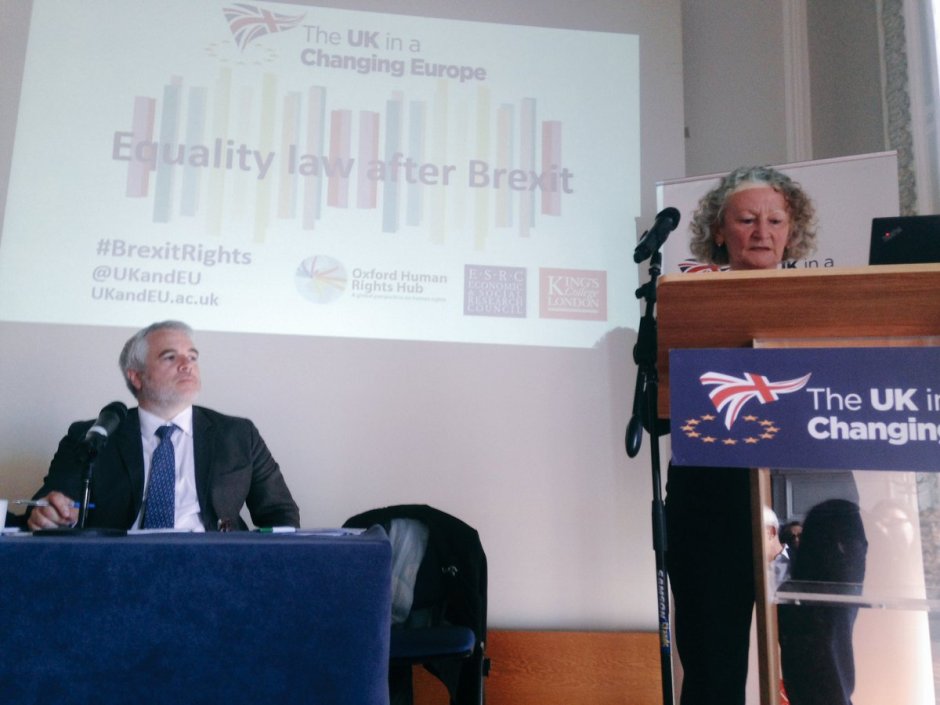
Equality laws post Brexit
Brexit is turning our world on its head. It will dominate our political, economic and social future. It’s certainly dominating Parliament’s attention at the moment, and we have got dozens of Bills coming up over the next few years to facilitate our smooth exit from the EU.
I’m worried about what Brexit means for our rights. I voted for Brexit, even campaigned for it, but I feel cheated now by the Government with some of the things they are trying to get away in the EU Withdrawal Bill. Continue reading “Equality laws post Brexit”
No three line Labour whip for Animal Sentience
At yesterday’s debate in the House of Lords on the EU Withdrawal Bill I had to drop my amendment to retain the EU’s rules on Animal Sentience, as part of the Withdrawal Bill, because Labour withdrew its two line whip just as I was about to push it to a vote. My amendment was the same that Caroline Lucas put to the Commons and received a lot of support. Continue reading “No three line Labour whip for Animal Sentience”
Withdrawal Bill debate shows why we need Lords reform
One of the surprises of life in the Lords is that our laws are partly decided by the bar room stamina of government supporting peers. The Lords defeated the government three times yesterday over the charter of fundamental rights and also earned a good concession from them over the protection of public health. The Opposition was on a roll and not one of the peers in the chamber got up to speak against the amendments sponsored by green NGOs to retain the EU’s environmental protections and principles. No one opposed, but vast numbers of Conservative peers were hanging out in the bars and restaurants, waiting for their whips to call them to vote. In the end, the Minister rose, made concessions and the amendment was withdrawn. Continue reading “Withdrawal Bill debate shows why we need Lords reform”
Lords can defeat government on EU rules
Object Today – No Third Runway!
Prompted by CPRE, I’ve emailed the following objection to expansion.feedback@heathrowconsultation.com Please do the same and add your voice by March 28th.
Remembering the police who put their lives on the line to keep us safe
It is one year since the tragedy in which five people were killed and 50 injured, as Khalid Masood ploughed a 4×4 vehicle into pedestrians on Westminster Bridge and stabbed unarmed police constable Keith Palmer to death as he stood on duty outside the Houses of Parliament. We are marking these awful events at Westminster with a minute’s silence.
It is an appropriate moment to remember all those police officers who put their lives on the line to keep us, the public, safe. Two weeks ago I wrote to Cressida Dick, the Metropolitan Police Commissioner, to ask that she does something to improve the working conditions of the armed officers on duty here.
Dear Commissioner
Over the past few months I’ve become increasingly concerned about the wellbeing and effectiveness of the armed officers who patrol the Palace of Westminster, both inside and outside. As the weather has got worse during the winter, two things have become obvious.
First, the welfare of the officers is under threat. Many have nowhere to shelter when it rains or snows, nor when the wind is strong. If they get wet during their two hour tour of duty, it’s almost impossible to dry out their clothes properly in their one hour off duty.
Secondly, cold, wet armed officers are potentially ineffective against a terrorist threat. Handling a weapon with cold hands is less than ideal, tactically inefficient and possibly even dangerous.
There are ways of improving the situation, eg supplying canvas shelter as at No 10 or the erection of more bulletproof guard houses as elsewhere on the estate, offering (discreet) hot drinks on cold wet days, or supplying properly waterproof kit, including caps. And they should be supplied with waterproof gloves, not have to buy their own.
I have raised this within the Palace of Westminster with peers but have had little support for improvement. I can’t help but feel that if I were arguing for police horses or police dogs, they would not be left exposed to the weather like the officers.
I hope you can do something quickly before the weather gets worse again.
Restoring credibility to the spy cops inquiry
After a dramatic walk out by campaigners and their legal teams, the inquiry into undercover policing is struggling to retain any credibility. I asked the Minister what action they would take.
By my calculation, there have only been four years out of the last twenty-five when an undercover police officer was not in a state funded sexual relationship with a female campaigner. These are just the ones that we know about.
Bob Lambert deployed between 1985 -1988, left behind ‘Jacqui’ with their toddler son. He also left behind an 18 month relationship with Belinda Harvey.
John Dines’ in the years 1987 – 1992.
Andy Coles deployed between 93 – 95 allegedly had a sexual relationship with a 19 year old activist, which lasted a year.
Mark Jenner, lived with a woman for five years during 1995 -2000.
Mark Kennedy was deployed between 2003 -2009 and had a long term relationship during this time.
In January we learned that Rick Gibson, who worked for the Special Demonstration Squad in the 1970s, is accussed of having had at least two sexual relationships, possible four, with campaigners during his deployment.
Given the regularity of these events, Ministers need to recognise that forming sexual relationships was used as a deliberate tactic by undercover officers over very many years.
Closing the environmental gaps in the Government’s Brexit Bill
The Government has allowed a series of late night sittings to deal with the Lords’ substantial opposition to its EU Withdrawal Bill. This opposition has been fuelled mainly by the Government’s failure to deal with the genuine concerns about the transfer of EU policies into UK legislation. Bringing across all the European rules and making them UK laws was meant to be the purpose of the Bill, but the amendments in the Lords have highlighted dozens of ways that the Government are trying to dump social and environmental protections.
Amendment 214, coming up at the next sitting, is one of five key amendments I have put my name on. It requires Ministers to make sure that EU Directives are properly implemented, so that we receive whatever benefits, rights, and remedies were intended by the Directive. Examples of Directives we have benefited from include the Working Time Directive and the Habitats Directive.
The big problem with the current approach (in the bill’s Clause 4) is that it will exclude legal rights simply because they haven’t yet been litigated on. It is a very odd approach for the Government to take in deciding that legal rights only exist once a Court has applied that specific right. The very nature of EU Directives means that there are whole frameworks which Governments may have simply taken for granted – but these could be lost simply because no one has sued the Government on them. This strikes me and many others as a perverse way to approach the issue.
The second big problem is where the Government has failed to properly implement EU Directives. At the moment, people have legal rights to take the Government to court where they have failed to meet their obligations under EU Directives. This will all be lost as a result of Clause 4.
One example of where we have failed to implement an EU Directive is Directive 2016/802. The Directive requires the strengthening of regulations to reduce the sulfur content of liquid fuels, but the UK regulations instead talk about imposing less regulation.
Another example is the Water Framework Directive which requires price incentives to encourage people to use water sustainably – but we haven’t done this.
Rather than making good on our obligations under EU law, the Government is trying to tear up whole swathes of EU law, and our environment and our health will be the biggest casualties. We must plug these gaps or we’ll all be much worse off, and so will our precious environment.
Heathrow: expanding an air pollution hotspot
On the same day that four Parliamentary Committees united to condemn government inaction over air pollution, the House of Lords debated the National Policy Statement (NPS) on the expansion of Heathrow. The former really ought to have an impact on the latter, but our Government doesn’t seem to be listening.
Heathrow already breaks air pollution limits. I’ve spent years listening to the supporters of expansion telling me what they would do to reduce pollution if they got the green light to add another runway. They never think to do those good things now and show they can reduce pollution down to legal limits ahead of expansion.
For all the talk of congestion charging and electric vehicles, the only thing guaranteed to happen at the airport is a bigger car park to cope with at least 40,000 to 60,000 extra vehicles a day on the roads.
The only new infrastructure in the Heathrow NPS is a tunnel for the M25 and moving some big roads around. There is no extra money for rail links, just aspirations. Yet, there are meant to be an extra 200,000 extra trips per day by public transport, a lot of them relying on the Metropolitan Line and Elizabeth Line, which Transport for London are upgrading anyway, to cope with anticipated overcrowding.
The NPS shows that expansion will negate all the benefits of the Mayor’s plans to reduce air pollution near Heathrow. We know that the pollution generated by expansion will shorten people’s lives. Despite this, I suspect that there are majorities within the Parliamentary Conservative and Labour Parties who will back expansion. So here are some other points about the Heathrow NPS.
No guarantee that regional airports and jobs won’t go into decline as Heathrow favours international routes.
No guarantee that taxpayers won’t be landed with a multi-billion pound bill to pay for new transport infrastructure.